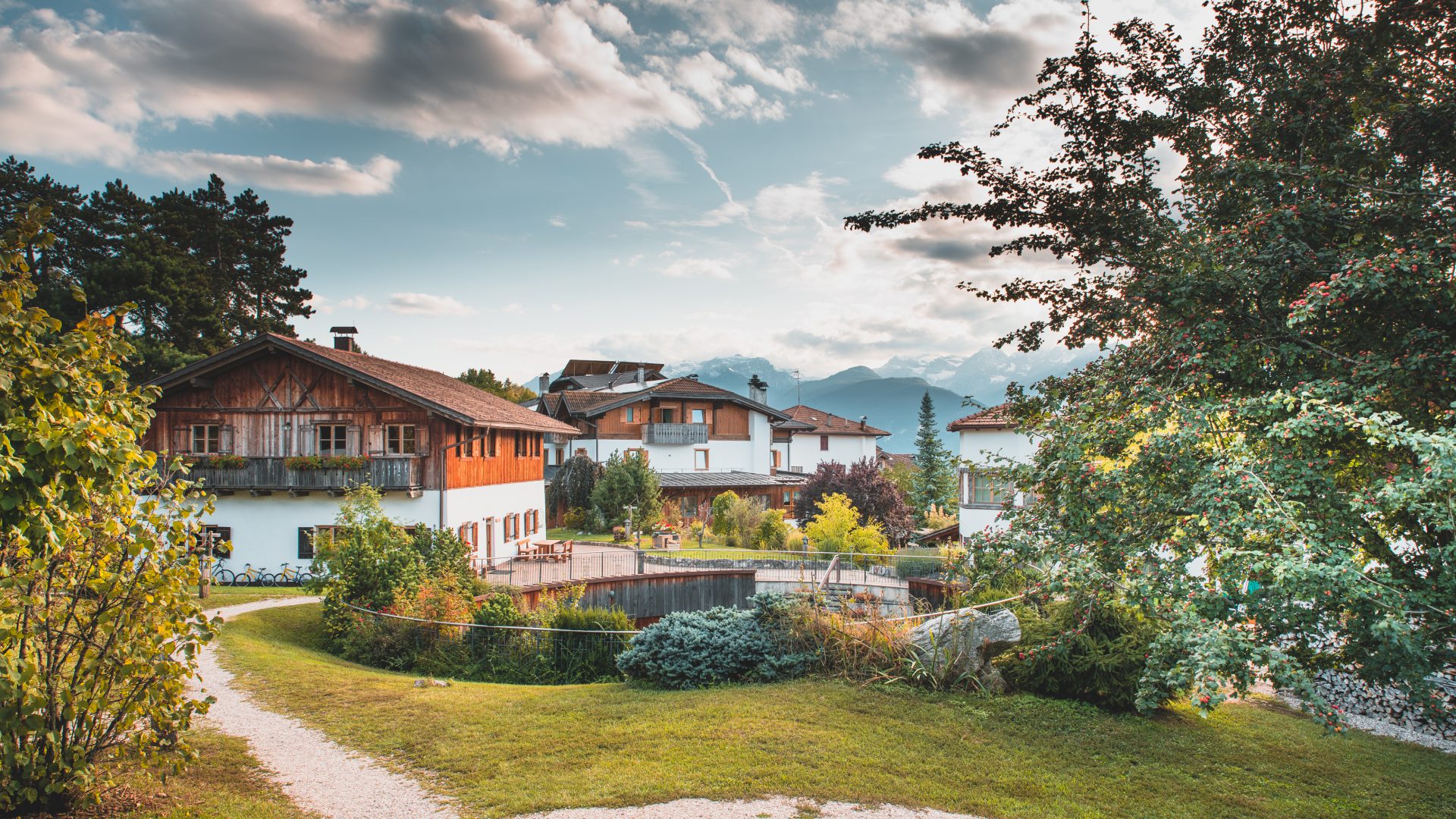
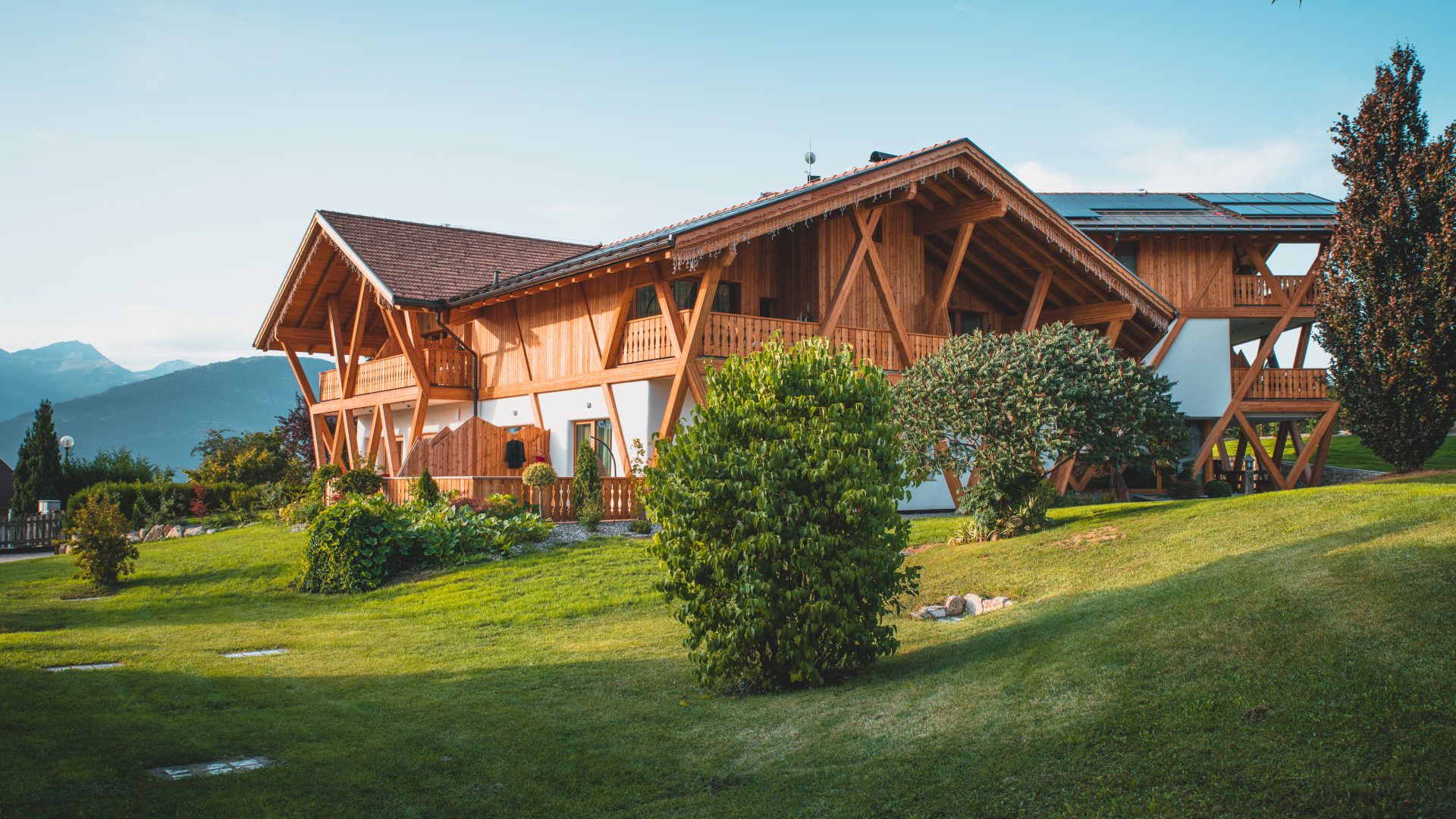
Some hotels try to concentrate everything within their own walls; others, by contrast, seem to need their surroundings to make complete sense. Pineta Nature Resort firmly belongs to the latter group. In Tavon, a hamlet of Predaia in Val di Non, it appears not as one large hotel building, but as a small village scattered through greenery: buildings, chalets and shared spaces converse with meadows and woods, allowing the landscape to remain part of the experience.
It is an aesthetic choice, but above all a measure of hospitality. Nicola Sicher explains it with a simple figure: the property accommodates around a hundred guests, and the family has no desire to grow beyond that. Not for lack of ambition, but because a larger size would risk taking away what is considered essential here: time to devote to people. Even when the resort is full, its spaces and activities naturally spread guests between garden, forest, excursions, tastings and wellness. Dinner is the main occasion when everyone really comes together.
Behind this approach lies a family story that began in 1954 with Elsa and Guido Sicher and grew over generations around food and hospitality. Even today, the family's presence is no mere facade: Mattia looks after the kitchen, Andreas the wine and dining room, and Nicola the relationship with the local area and many of the activities. Perhaps it is this daily continuity, more than any category label, that explains Pineta's character.
The valley as part of the hotel
Val di Non has not developed tourism as intensively as other Alpine areas. For the Sicher family, this apparent limitation has gradually become a way of working. “We have always been open to our local area,” Nicola explains. The need to build an interesting offering encouraged Pineta to forge relationships with what was already around it: dairies, wineries, livestock farmers, honey producers, small craftspeople and farms.
The result is an ecosystem in which the hotel does not seek to replace the destination, but acts almost as its gateway. The agricultural landscape itself speaks eloquently of the valley's complexity. Apples, now the undisputed symbol of Val di Non, became dominant mainly from the 1970s onwards, gradually replacing a more fragmented, subsistence-based agriculture. The cooperative system then strengthened smallholdings. Today tourism is also becoming part of this story, with orchard-related experiences ranging from harvesting with farmers to visits exploring storage systems.
As you climb higher, the productive landscape changes: alongside apples come berries, cherries, pastures, potatoes and, increasingly, vineyards. It is precisely these layers that make Pineta's approach interesting: not a sequence of attractions created for visitors, but the chance to encounter activities that truly belong to the valley.
Wine moves uphill
Perhaps the most surprising chapter concerns wine. In a region immediately associated with apple orchards, viticulture is seeking new spaces and new altitudes. Alongside Groppello, a historic presence in Val di Non, small-scale production is emerging that also involves resistant grape varieties, capable of opening up interesting possibilities at higher elevations.
In Coredo, one of the experiences offered by the resort leads to Vin de la Neu, the project of Val di Non winemaker Nicola Biasi. In 2012, Biasi chose to replace the apple trees on the family property with a Johanniter vineyard, taking the risk of working with a variety then almost unexplored in the area. From that initial core, the project has grown through additional plots and research strongly focused on sustainability. It is a story that connects naturally with Pineta, because it expresses the same idea of place: start with what exists, study it and try to imagine a different path.
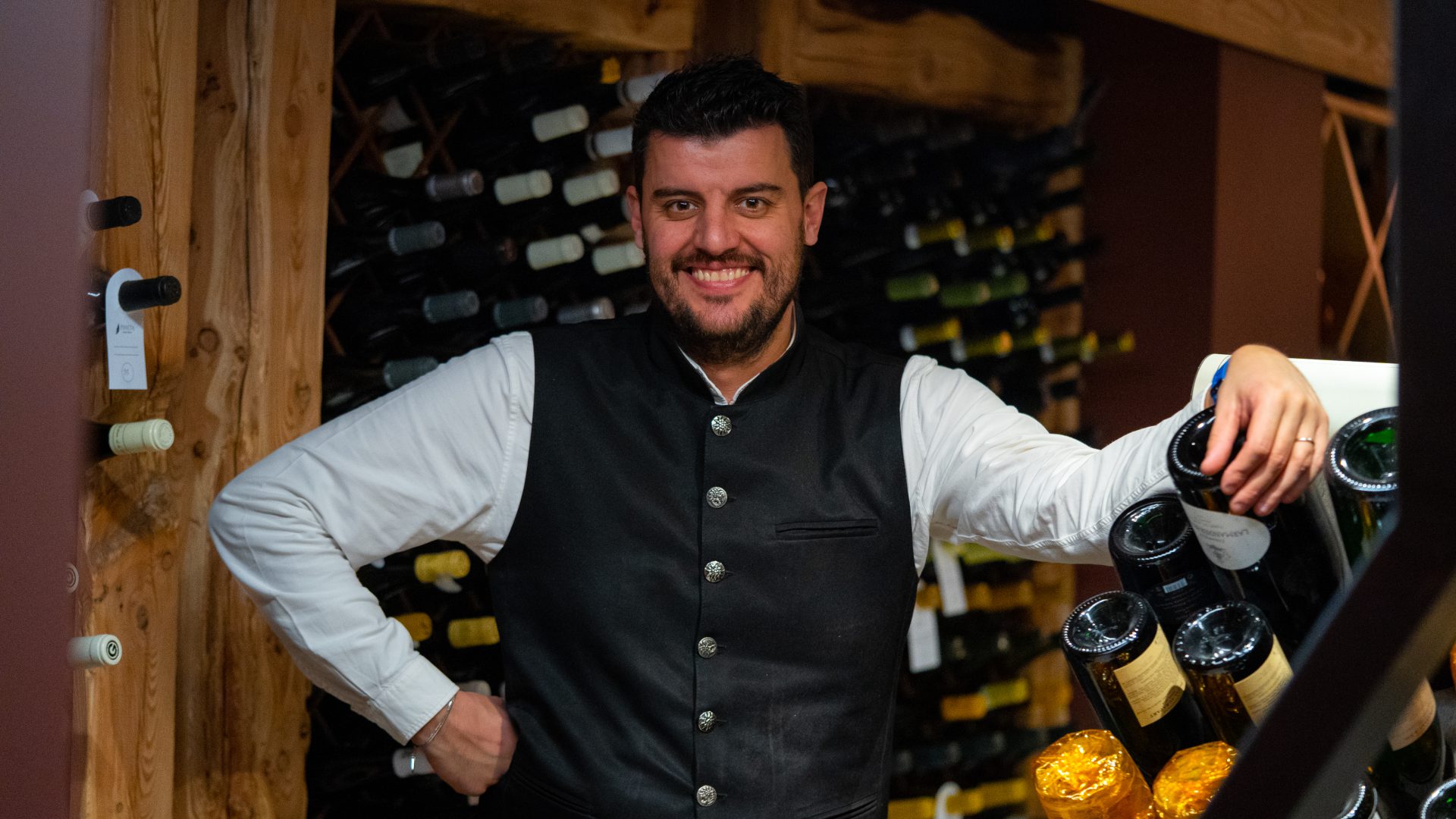
The resort has turned this proximity into a genuine wine hospitality project. “Cantine amiche del Pineta” connects producers and guests throughout the year, alternating tastings, encounters, visits and personalised itineraries. Pineta's Enoteca becomes a place for advice and discovery, while the Secret Cianva — a tiny setting designed for two — offers private experiences. The logic is simple: let guests discover wine without the pressure of having to leave, and above all without having to drive again after a tasting.
One of the activities even sets off on foot from the resort: accompanied by sommelier Gaia, guests reach the Vin de la Neu vineyards, also taste wines associated with Nicola Biasi's Resistenti network and return along a circular route through the agricultural landscape. Wine thus stops being an extra service at the table and becomes a way to understand the valley.
A home born around the table
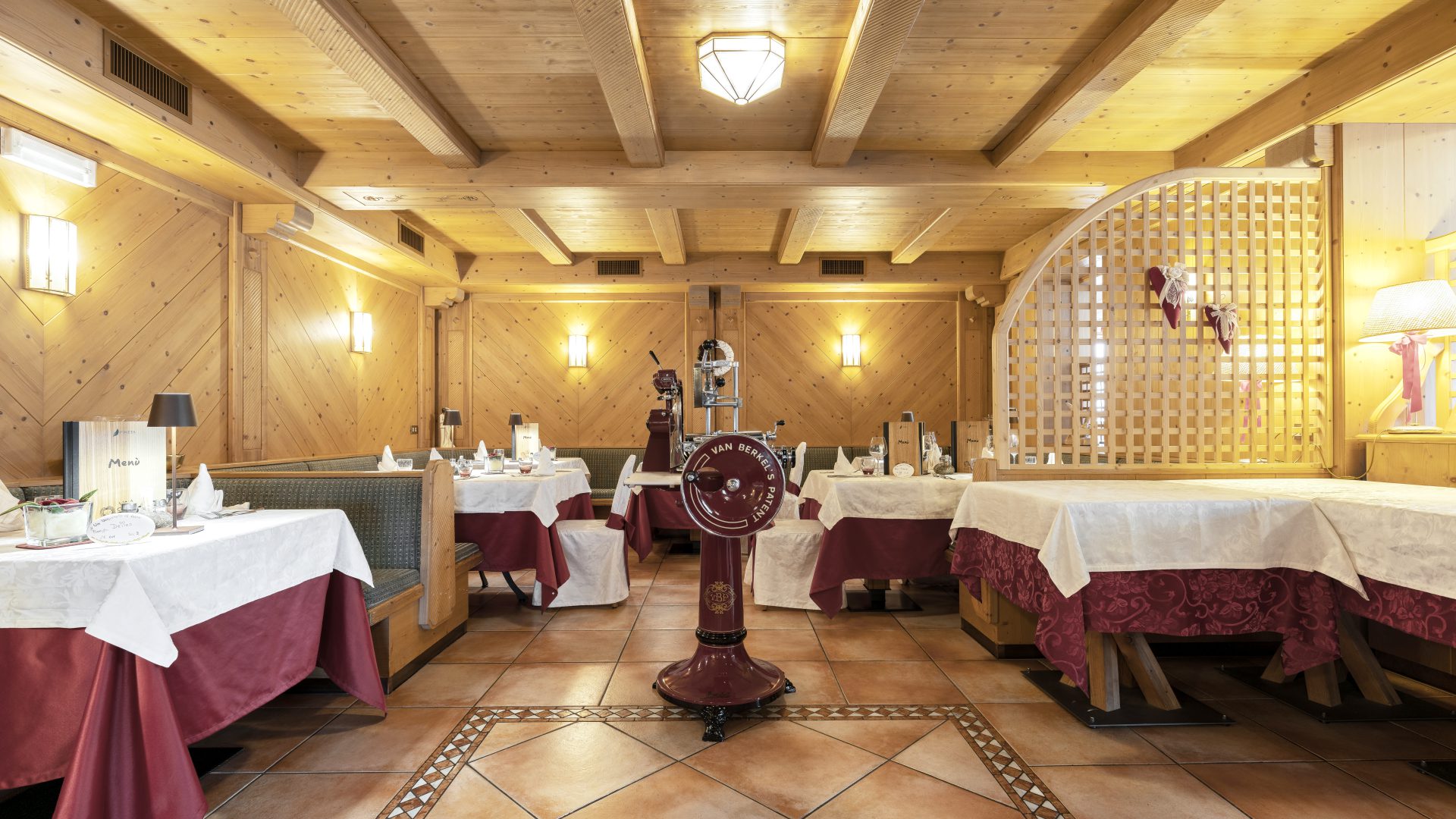
Food remains one of the constants. “We started out as restaurateurs,” Nicola recalls, a sentence that explains why the kitchen at Pineta is not seen as a separate hotel department. Mattia Sicher works with the traditions of Trentino and Val di Non, seasonality and a network of suppliers that brings a tangible part of the region onto the plate. Andreas Sicher, meanwhile, builds the dialogue with wine through an extensive cellar, paying particular attention to Trentino without neglecting Italian and European labels.
Ristorante Alla Pineta preserves dishes and preparations deeply rooted in local identity — from tortel di patate potato fritters to smalzadi dumplings, from Casolet cheese to desserts from the family tradition — without turning them into a folkloric performance. What matters above all is continuity between kitchen and place: the same producers encountered on a visit may reappear at the table, and a bottle discovered in a cellar may be found in the glass that evening.
It is here that the concept of a dispersed resort takes on a further meaning. Pineta is not only spread across physical space; it is also distributed through the network of relationships it builds around itself. The gastronomic experience becomes the moment when many of those threads come together again.
The forest as a place of wellbeing
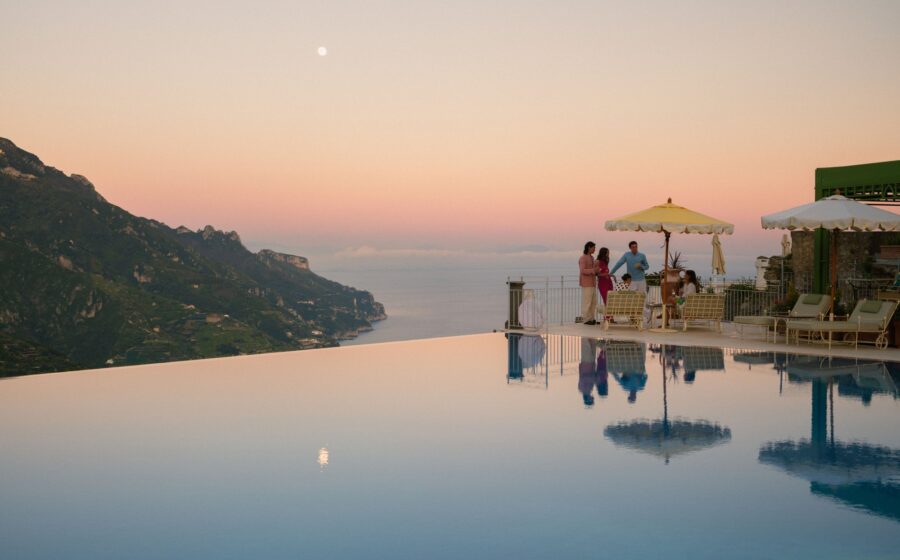
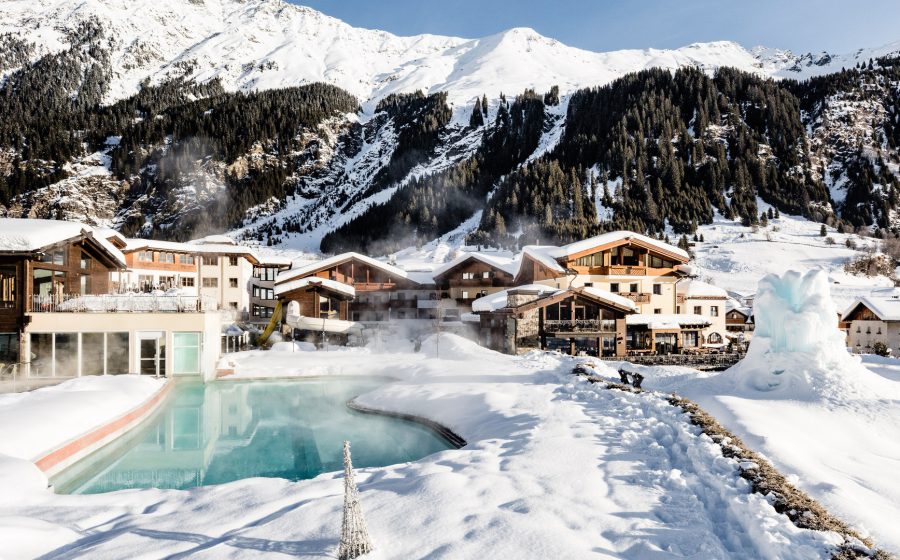
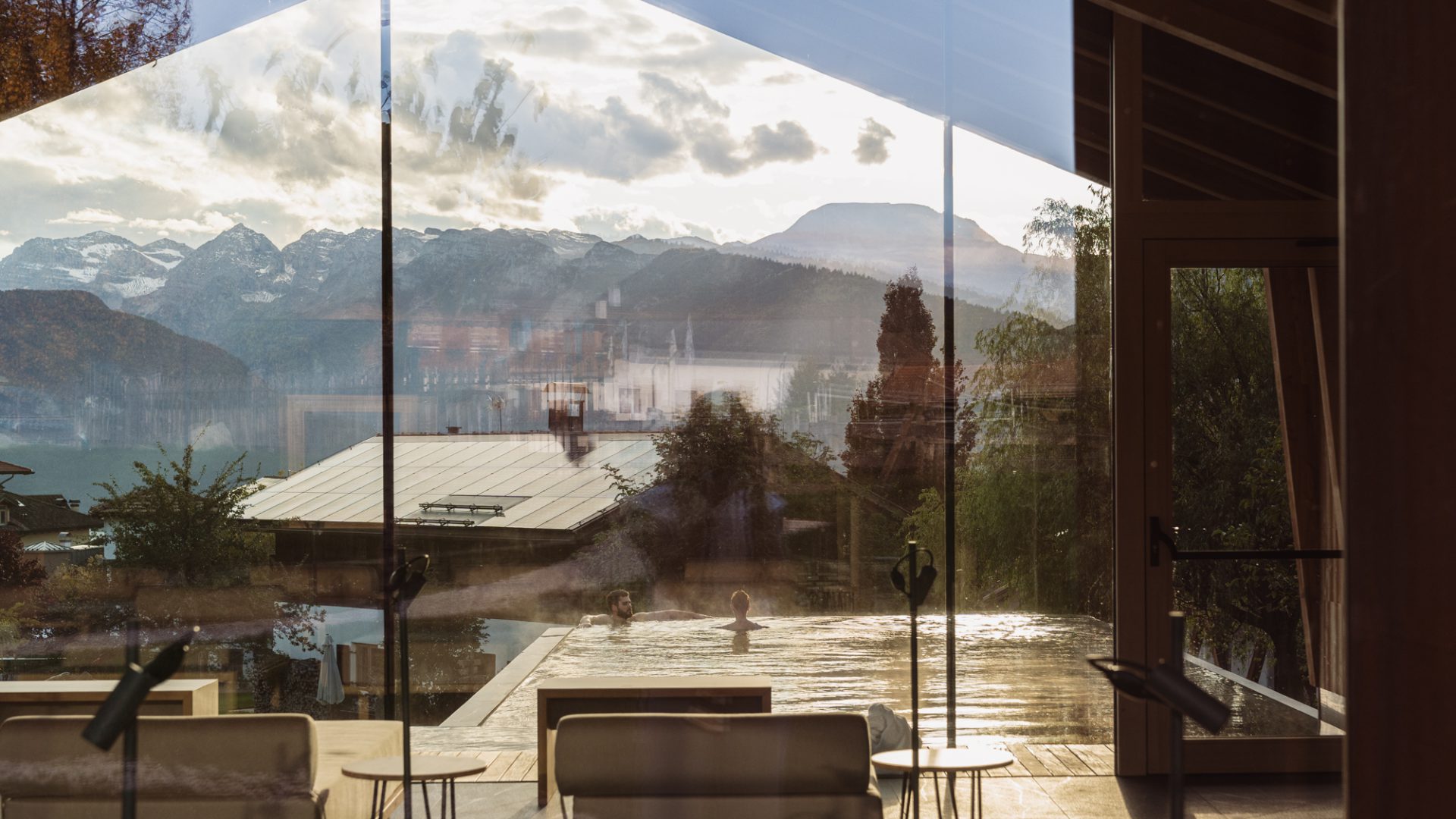
The wellness offering follows the same grammar. Pineta Nature SPA covers around 1,200 square metres, with an Infinity Pool overlooking the Brenta Dolomites, indoor and outdoor whirlpools, aromatic saunas, a steam room, a Roman laconicum, a hay grotto, a Kneipp circuit and a swimming pool. But the most interesting part is what happens just beyond its doors.
The Nature Therapy programme brings wellbeing into the landscape through walks, forest bathing, breathing practices, yoga, meditation, outdoor activities and time in the woods. Even the new amphitheatre, with loungers immersed in greenery and an open-air whirlpool, seems intent on erasing the boundary between property and nature. The aim is less to multiply the options than to bring them back to a coherent idea: using a stay to change your pace.
In this sense, the seasons become the resort's true calendar. Spring brings apple blossom and the awakening of the woods; summer leads onto trails and to lakes; autumn introduces the apple harvest, the grape harvest, mushrooms and foliage; winter changes the landscape and activities once again. Pineta remains open for much of the year, with a break between February and March for building work and maintenance, and adjusts its offering to what is happening outside rather than imposing an unchanging programme on the region.
The right scale
In a sector that often equates evolution with increasing size, Pineta has chosen a less obvious direction. Growing here means adding substance rather than rooms: a new collaboration, a producer to discover, a route through the woods, a winery, an experience that gives guests a reason to better understand the place where they are staying. Human connection thus becomes a decisive element of the holiday. Pineta's luxury, then, is not isolation from the surrounding area. It is almost the opposite: having enough space and enough time to truly become part of it.
Perhaps this is its most precise identity. A hotel that does not want to become a self-sufficient world, but uses hospitality to connect different worlds: forest and table, apple and vine, family and guests, wellbeing and movement. Staying small, in this case, does not mean giving up on growth. It means choosing carefully which direction to grow in.
Sources and images: English translation of the complete article from James issue 32. Photo credits in the captions.