A short walk from Villa Borghese and Rome’s best-known shopping streets, close to Via Veneto, Sofitel Rome Villa Borghese occupies a privileged position at the heart of a city seemingly enjoying a new period of energy and vitality. In the places that once formed the backdrop to Fellini’s La Dolce Vita, there is a desire to rediscover the elegance, social life and ability to welcome the world that made Rome unique. The hotel interprets this atmosphere through hospitality blending the appeal of Italian classicism with French elegance. Its character is also shaped by French Zest, the touch of France that belongs to Sofitel’s identity. More than a tribute to Parisian style, it is a philosophy expressed through attention to design, a personal welcome and a culinary offering that celebrates local traditions through French savoir-faire.
Housed in a nineteenth-century aristocratic palazzo, the hotel was reinterpreted in 2019 by architect and interior designer Jean-Philippe Nuel, who transformed it into a haven of charm where history and contemporary design coexist naturally. The project draws inspiration from Rome’s grandeur and the green landscape of nearby Villa Borghese. Luminous colours, decorative motifs recalling nature and fine materials establish a dialogue between the interiors and the outside world, conveying the atmosphere of a Roman residence with a French accent. In the public spaces, marble mosaic floors and the building’s original tiles reflect attention to its architectural memory, while contemporary interventions renew its character. The 78 rooms, including seven suites, follow the same philosophy: intimate, carefully considered interiors, frescoed ceilings evoking Baroque skies, bespoke furnishings and marble bathrooms filled with natural light. Every detail contributes to an atmosphere of discreet elegance, far removed from ostentation.
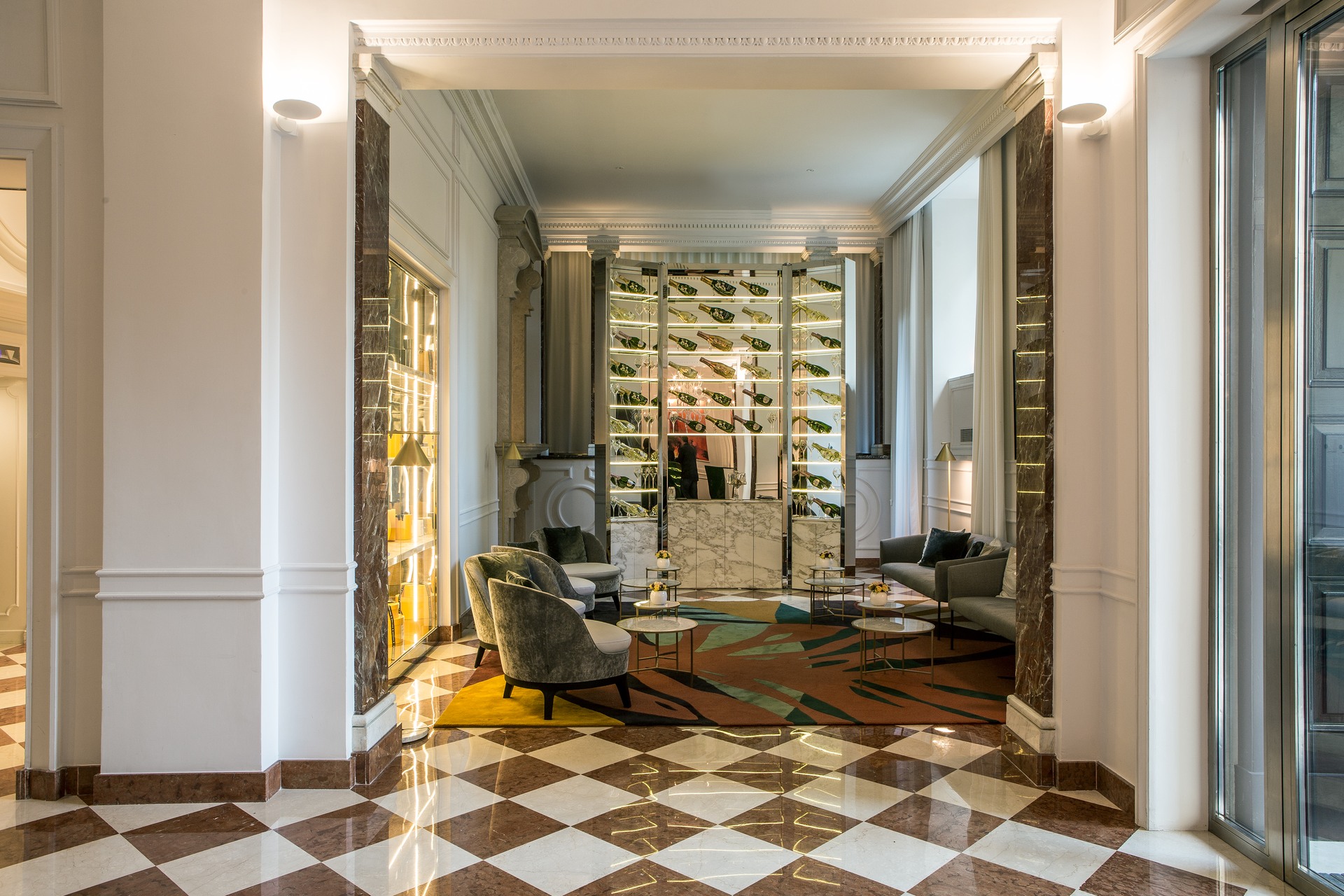
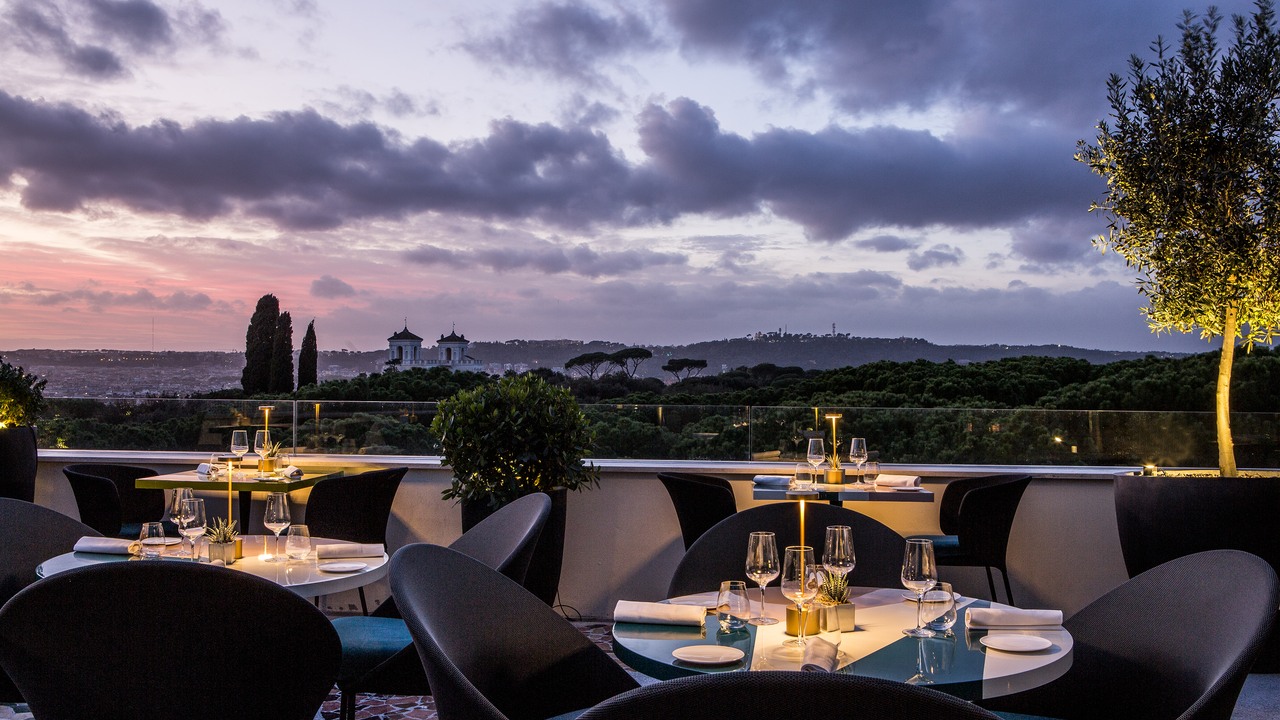
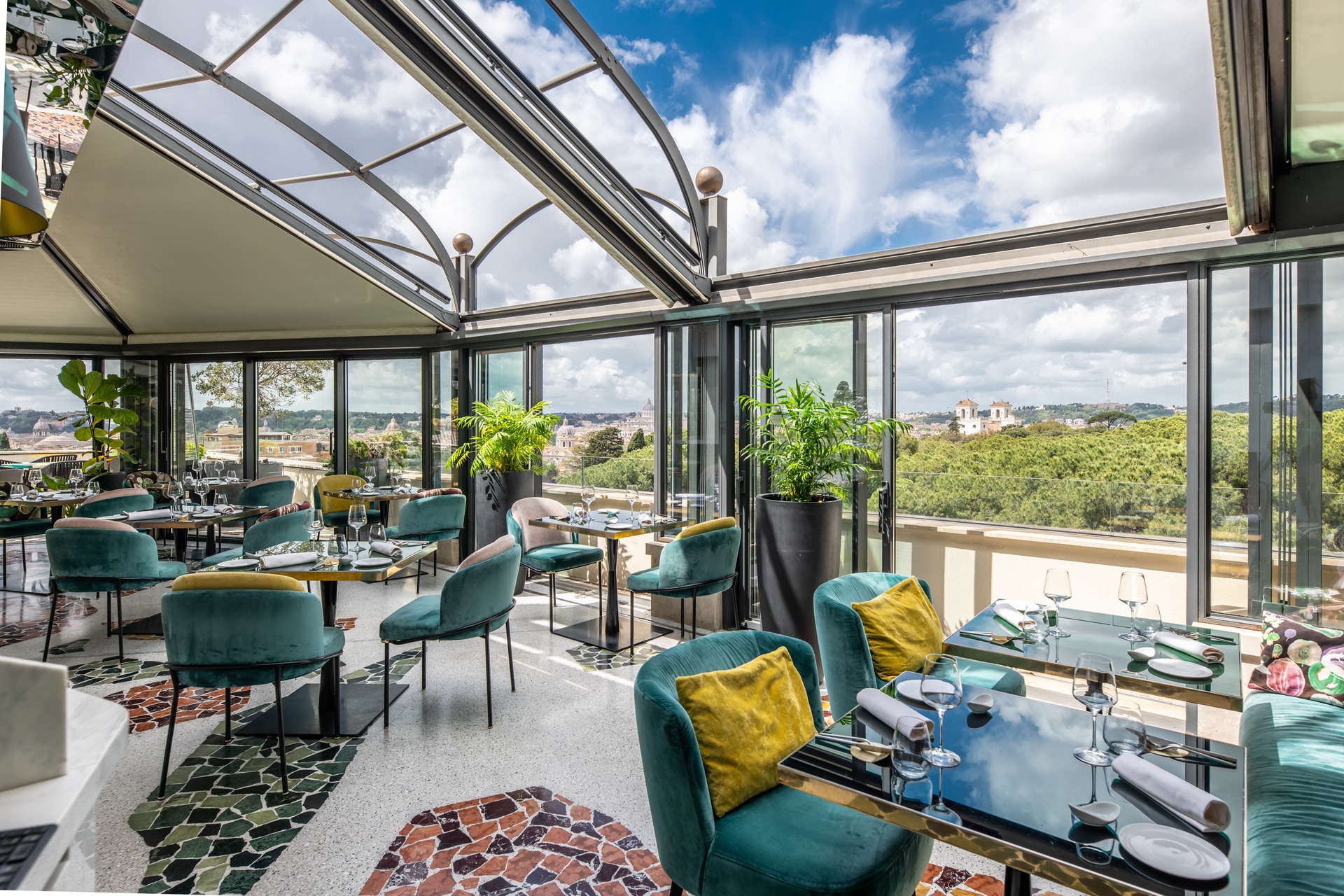
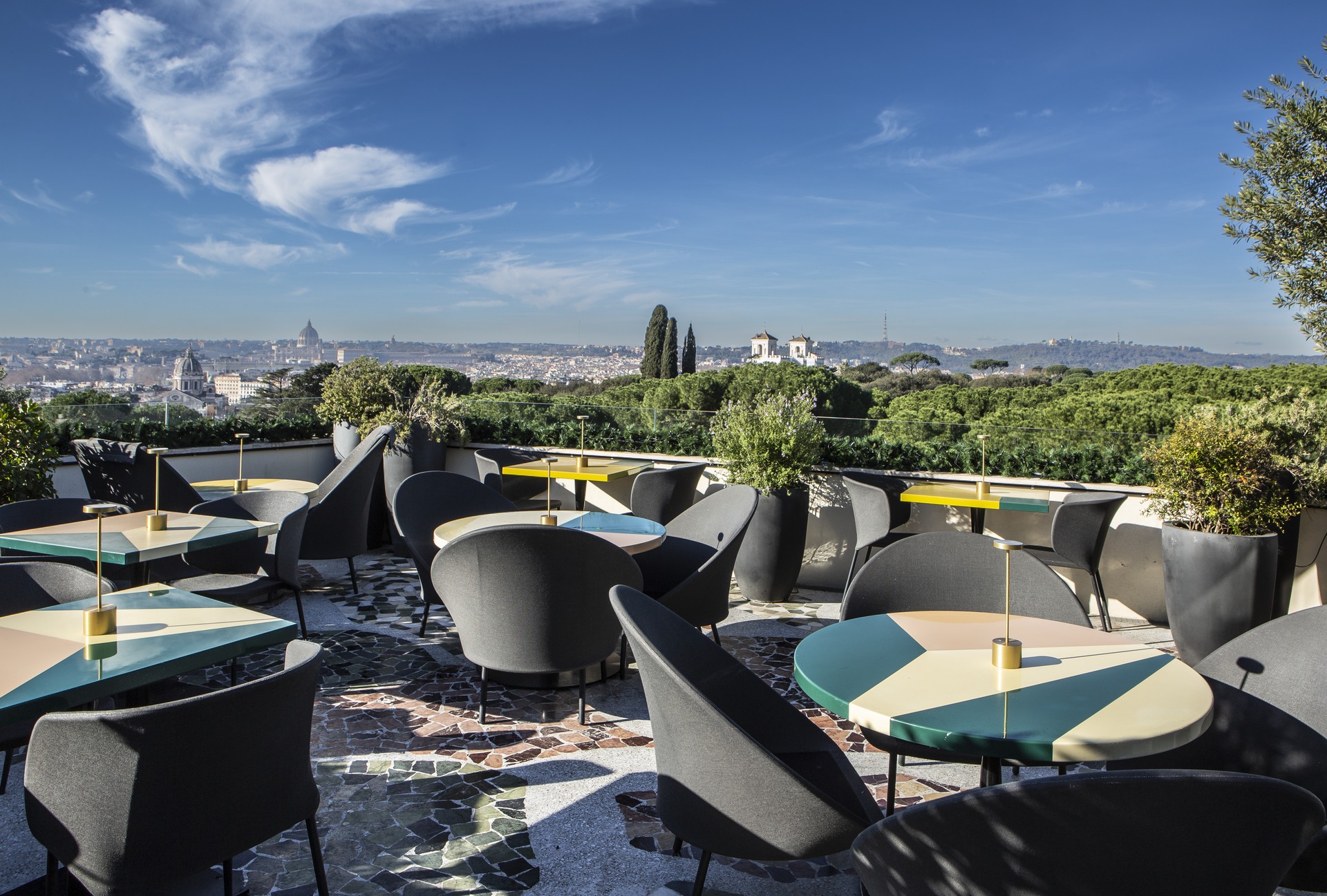
This meeting of Rome and France finds one of its expressions on the seventh floor, where the rooftop houses Settimo restaurant. The view opens over the gardens of Villa Medici and Villa Borghese, reaching as far as the dome of Saint Peter’s. This terrace above the city is a place where cooking interprets traditional Roman flavours with an international sensibility, bringing together local authenticity and French savoir-faire.
Attention to hospitality is accompanied by care for the environment. In 2025 Sofitel Rome Villa Borghese obtained the international Green Key certification, recognising accommodation providers’ commitment to sustainable management, reduced consumption and the protection of natural resources. The achievement demonstrates how contemporary luxury can also find expression in environmental responsibility. Yet hospitality at Sofitel extends beyond its interiors, dining and service. Perhaps its most interesting expression is the ability to accompany guests beyond the hotel, introducing a less predictable Rome of stories, artistic details and places normally absent from conventional itineraries.
A guide to reading the city
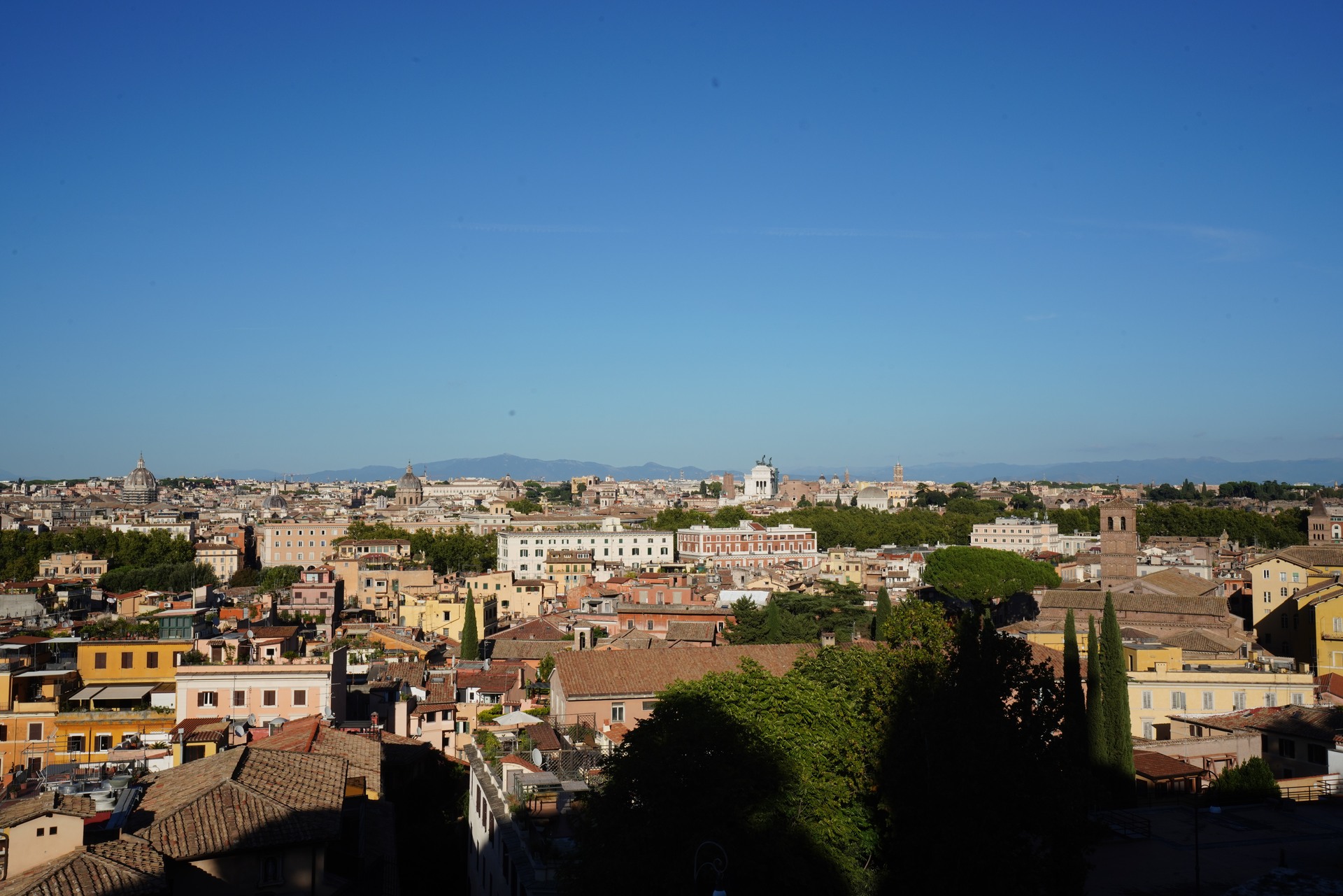
It is on the panoramic terrace, looking towards the gardens of historic villas and the dome of Saint Peter’s, that Mauro Parmesani, accompanied by his daughter Martina, meets Gioia Reali. A Roman by birth, with a degree in art history and a diploma in restoration, she worked for ten years as a restorer in Rome and numerous other Italian cities. For fourteen years she has turned her passion for art into what she considers the finest profession in the world: guiding small groups and families through the Eternal City on original visits designed to engage adults and children alike.
Her work extends beyond urban walks. In her studio, a short distance from Piazza Navona, she and three friends organise workshops devoted to artistic techniques: mosaic, fresco painting, watercolour, ceramics and painting. It is a place where theoretical knowledge gives way to working with the hands, and where art can be understood not only through observation but by attempting to reproduce its gestures and secrets. Appropriately, her business card bears the words “Michelangelo for a Day”.
Gioia’s relationship with Sofitel stems from the hotel’s desire to offer guests experiences that extend beyond their stay through distinctive itineraries. These are opportunities to develop a connection with the city, learning to read details that often escape even the most attentive eye. One of the most curious examples is what Gioia calls the Marble Zoo: an unusual treasure hunt through Roman squares and monuments, seeking animals carved in stone, hidden among fountains, façades and architectural decoration. It is only apparently a game: behind each figure lie historical references, heraldic symbols, political meanings and stories that offer a glimpse of Baroque Rome.
A marble zoo
The route begins in Piazza di Spagna. At the famous Barcaccia Fountain, made by Pietro Bernini with the probable contribution of his son Gian Lorenzo, Gioia invites visitors to find the bees, emblems of the Barberini family. Small details take centre stage, making a familiar monument appear new. The hunt continues towards the Trevi Fountain, among the marine figures and hippocamps that animate its monumental setting, before reaching the Pantheon. Here, almost concealed on a capital, another Barberini bee appears: a small clue revealing how deeply the symbolism of Rome’s great families was embedded in the city’s decoration.
In Piazza Navona the game becomes a veritable stone safari. Lions, horses, crabs and turtles populate the fountains and decorative features, forming a small animal universe that, in the seventeenth century, helped evoke a distant, exotic and mysterious world. Then comes the elephant in Piazza della Minerva, carved by Ercole Ferrata to a design by Gian Lorenzo Bernini and supporting the obelisk: a surprising, almost ironic presence that seems to have stepped out of a fantastic tale.
Casino Boncompagni Ludovisi
The route also reveals this aspect of Rome: a city that does not simply display its masterpieces but scatters them with clues. A change of perspective, a slower pace and the guidance of someone who understands the language of its stones are all it takes. The account of Gioia’s collaboration with Sofitel also includes another private visit. A short distance from the hotel stands Casino Boncompagni Ludovisi, a private residence of the Boncompagni Ludovisi family. The visit described leads into a place normally outside the tourist circuit, preserving works of exceptional artistic importance: Guercino’s wall paintings and, above all, the only known mural by Caravaggio, painted in oil and entitled Jupiter, Neptune and Pluto.
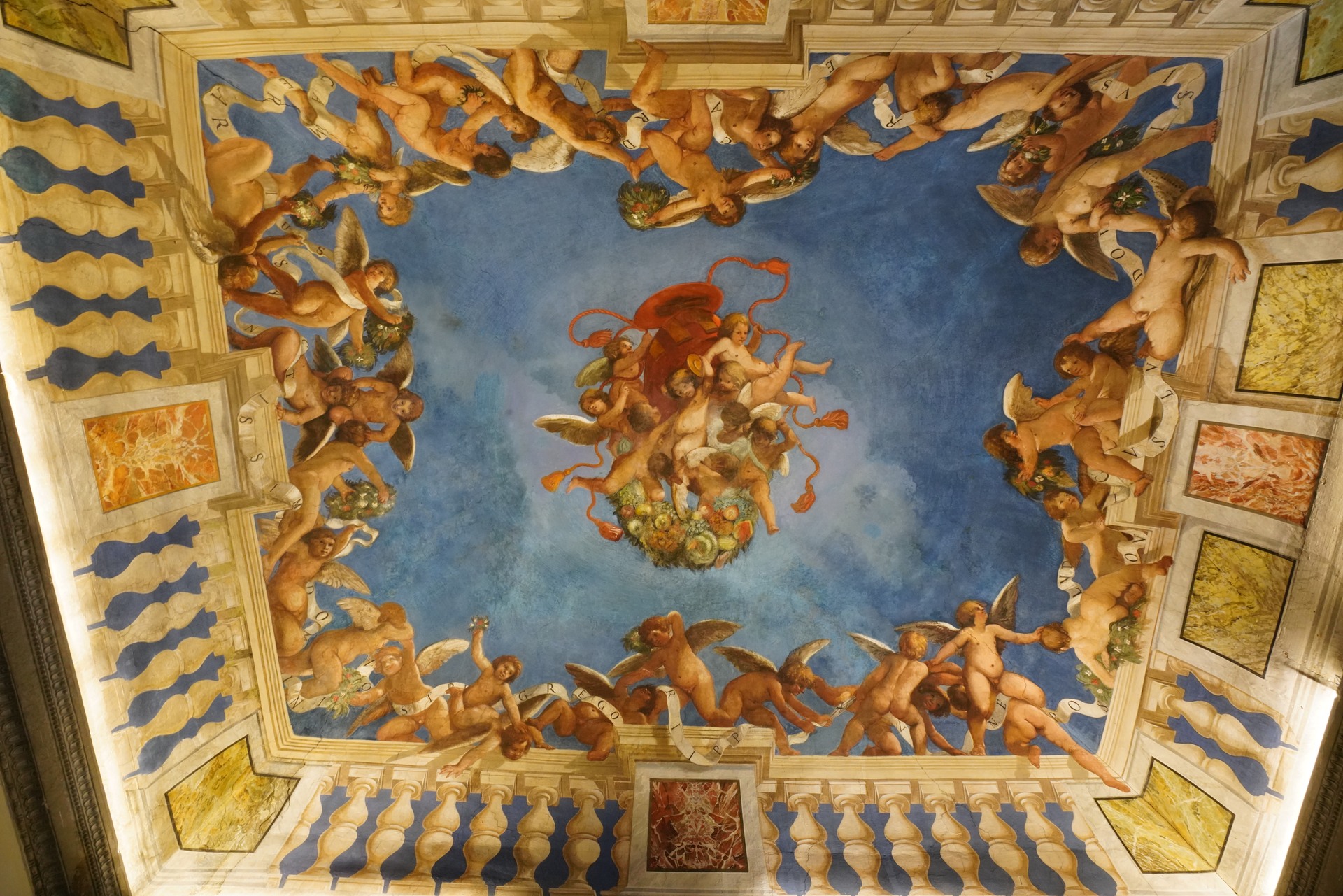
In Gioia’s account, Prince Francesco Boncompagni Ludovisi himself has welcomed guests on several occasions, accompanying them through the history of the residence and family with anecdotes and personal memories. This gives the visit a particular dimension: it is not simply an entry into a historic palazzo, but into a home preserving a family’s memory and relationship with its past. Gioia makes no secret of her emotion when discussing this opportunity. After a lifetime devoted to studying art history and artistic techniques, being able to visit the residence, welcome guests and show its works felt to her like a dream come true.
In Caravaggio’s footsteps
This friendship has led to a collaboration involving Sofitel, Gioia and Prince Boncompagni Ludovisi in Sulle orme di Caravaggio, a painting workshop inspired by the artist’s still-life compositions. The experience introduces painting through principles that guided masters’ work for centuries. In the workshop described, participants spend around two hours learning to prepare and combine colours, observing nuances, composing shades and finally drawing and painting. No particular skill is required: each participant can explore their creativity or simply become acquainted with the practice of painting, discovering the work, knowledge and sensitivity behind a painting. It offers a different approach to Caravaggio, going beyond contemplation of a work to explore its language, material and relationship with light. The same light that made his painting unmistakable centuries ago.
Finally, returning in memory to Sofitel’s terrace and the panorama over Rome’s rooftops, the meaning of these experiences becomes clear. The Eternal City never stops telling its stories, but hearing them requires looking beyond its best-known places. Sometimes it is enough to follow the trace of a bee carved in marble; at other times, to cross the threshold of a private residence or pick up a brush, rediscovering an artist’s greatness through an ancient gesture. This is the Rome Gioia helps visitors encounter: a city to be lived in rather than merely visited, where even a simple itinerary can become a discovery. And where the art of hospitality, meeting passion and knowledge, can itself become a travel experience.
Sources and images: Photo credits: Gilles Trillard (sunset terrace and lobby); Gilles Trillard / Accor (daytime terrace); Mauro Parmesani (Rome panorama and Casino Boncompagni Ludovisi ceiling); Sofitel Rome Villa Borghese (restaurant). All image rights are reserved to their respective rights holders.